
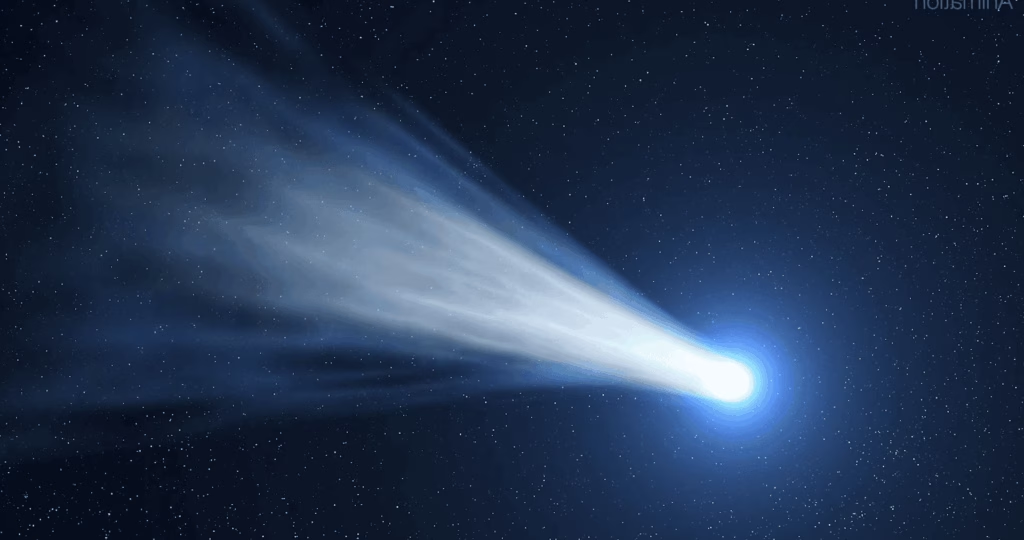
If you’ve been scrolling through your social media feed lately, you might have seen some wild headlines claiming that a mysterious alien spacecraft is racing toward Earth and could wipe us out as soon as this November. Sounds like something out of a sci-fi movie, right? Well, let’s get this out of the way first — that’s not true. There is no alien ship coming to destroy us. But the real story behind this rumor is still fascinating and worth knowing.
What sparked all this buzz is a cosmic traveler called 3I/ATLAS. And while it’s definitely not an alien ship, it is something very rare and exciting. In fact, it’s only the third time in history we’ve spotted something like this. Scientists call it an “interstellar object,” which means it wasn’t born in our solar system, it came from somewhere else in the galaxy. The first one we saw was 1I/ʻOumuamua back in 2017, and the second was 2I/Borisov in 2019. Now, 3I/ATLAS has joined the club.
How 3I/ATLAS Was Found
The discovery happened thanks to the Asteroid Terrestrial-impact Last Alert System (ATLAS) telescope in Río Hurtado, Chile. That’s actually where the comet’s name comes from. When astronomers spotted it, the comet was an incredible 420 million miles (676 million kilometers) away from the Sun.
Since then, scientists have been studying it closely using powerful telescopes both on the ground and in space. We have a window of opportunity to observe it until September, before it gets too close to the Sun and becomes hidden from view. After that, it will reappear again around early December.
Clearing Up the Alien Rumors
The alien spacecraft stories might make for fun reading, but the real facts are just as awe-inspiring. The latest and sharpest images of 3I/ATLAS come from the legendary Hubble Space Telescope, which has been giving us space insights for decades. A team of astronomers recently shared new details based on Hubble’s observations, showing us this comet in more detail than ever before.
How Big Is This Thing?
One of the main questions scientists are trying to answer is: how big is 3I/ATLAS? According to the latest data, the solid core called the nucleus could be as large as 3.5 miles (5.6 kilometers) across, or as small as 1,000 feet (320 meters). That’s a pretty wide range, but even this estimate is a big improvement over what ground-based telescopes could tell us.
The problem is that the nucleus itself can’t be directly seen right now. What Hubble can see is a dust plume coming from the side of the comet that faces the Sun, as well as a dust tail trailing behind it. Interestingly, the amount of dust it’s losing is about the same as comets from our own solar system that were first spotted from around 300 million miles away.
The Fastest Visitor We’ve Ever Seen
Here’s where things get even more exciting, 3I/ATLAS is moving at an unbelievable speed of 130,000 mph (209,000 kph). That makes it the fastest visitor we’ve ever detected in our solar system.
Why so fast? Well, since it came from beyond our solar system, it has probably been traveling through space for billions of years. Along the way, it would have passed near stars, nebulae, and other massive objects. Each close encounter could have acted like a gravitational slingshot, giving it a speed boost. Over time, these boosts added up, and now it’s blazing through our cosmic neighborhood at record-breaking speed.
Is There Any Danger to Earth?
Here’s the good news — 3I/ATLAS poses no threat to Earth. In October, when it makes its closest pass, it will still be 149 million miles (240 million kilometers) away from us. That’s about the same distance as the Sun is from Earth.
Even though there’s no danger, scientists are keeping a close eye on it. Space observatories like the James Webb Space Telescope, TESS (Transiting Exoplanet Survey Satellite), the Neil Gehrels Swift Observatory, and the W. M. Keck Observatory are all gathering as much data as possible. One of the big focuses now is figuring out the comet’s chemical makeup — essentially, what it’s made of.
Why We’re Seeing More Interstellar Visitors
You might be wondering — if we’ve found three interstellar objects in less than a decade, does that mean more are coming? Should we be worried? The answer is no. Scientists believe these visitors are actually pretty common. It’s just that until recently, our technology wasn’t advanced enough to spot them.
It’s similar to the way we track near-Earth asteroids. We know thousands are out there, but we’ve only detected a portion of them so far. As our telescopes and detection systems improve, we’ll likely discover more and more interstellar travelers passing through our solar system.
The Future of Interstellar Exploration
Every interstellar object we find has the potential to teach us something new about the universe. The big challenge is being able to study them up close before they zoom away forever. That’s why the European Space Agency (ESA) is working on something called the Comet Interceptor.
Scheduled to launch near the end of this decade, the Comet Interceptor will wait in a strategic position in space at a location called the Sun-Earth Lagrange point L2 — ready to spring into action when a new target appears. The goal is to get close to one of these visitors and capture detailed data that could change how we understand the cosmos.
The Wonder of a Cosmic Guest
In the end, 3I/ATLAS is a reminder of just how big and mysterious our universe is. It’s a traveler from an unknown place, carrying clues about worlds we may never see. Even though it’s not an alien ship, its journey across the stars makes it one of the most exciting stories in space science today.
So, the next time you see a sensational headline about an alien invasion, remember this, the truth might not involve little green men, but it can still be just as amazing.
Source: NASA Goddard