
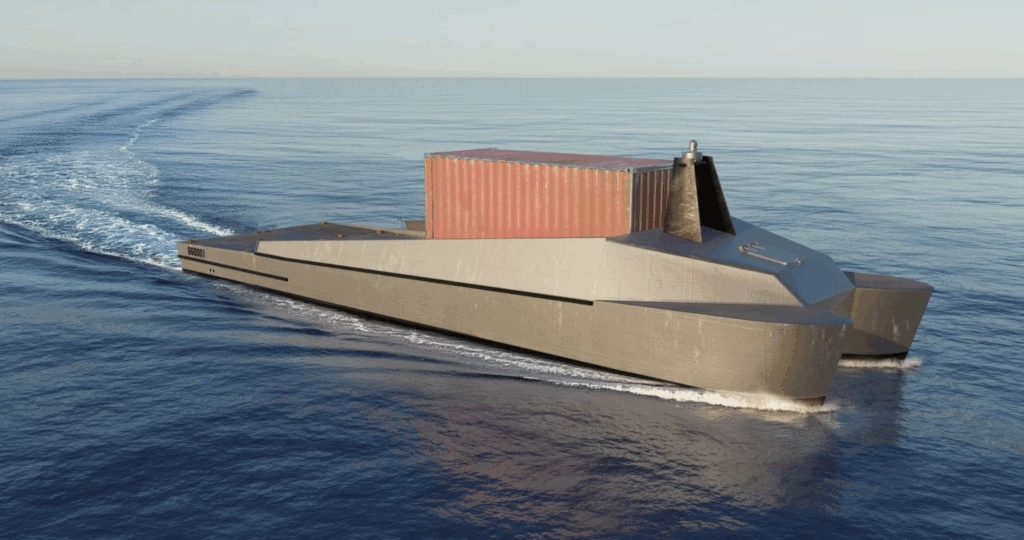
At first glance, you might mistake it for a futuristic catamaran or even something straight out of a sci-fi movie. With its sleek aluminum frame and hints of Cybertruck-like design, BlackSea Technologies’ Modular Attack Surface Craft—better known as the MASC—isn’t your average naval vessel. This is a warship built to think differently, designed from the keel up to embrace autonomy in a way that feels like the natural next step for modern naval fleets.
And if you think that’s just another buzzword, hold on. The MASC isn’t just a fancy piece of aluminum cutting through the waves. It’s a bold statement about how naval warfare, logistics, and maritime defense could transform in the coming decades.
A New Wave of Autonomous Warships
Over the past few years, we’ve seen a steady rise in autonomous naval craft. From sleek unmanned submarines to experimental drone ships, the idea of machines carrying out dangerous missions without putting sailors in harm’s way has been steadily gaining traction. But many of those attempts have felt a bit… transitional.
Most unmanned vessels so far are either retrofitted from commercial hulls—think a cargo ship that’s been stripped and reprogrammed—or built as downsized versions of traditional warships. They’re functional, yes, but they’re still tied to old ways of thinking about ship design.
That’s where BlackSea Technologies took a different approach. Instead of forcing autonomy into an existing naval mold, they asked a simple but powerful question: what happens if we design a vessel to be autonomous from the very start? The MASC is their answer.
From Recon Craft to Full Fledged Warship
The MASC didn’t appear out of thin air. Its design is based heavily on BlackSea’s earlier success, the Global Autonomous Reconnaissance Craft, or GARC. About 75% of the MASC is shared with its predecessor, which already proved that modular autonomous vessels could operate effectively in real-world conditions.
But while the GARC focused more on reconnaissance, the MASC takes things to a whole new level. It’s built to meet—and in many cases exceed—the U.S. Navy’s latest requirements for unmanned surface vessels. These requirements, laid out in the Navy’s July 2025 solicitation, set the bar for what medium and large autonomous ships should be able to do.
The key? Flexibility. The Navy wants vessels that can adapt on the fly, that don’t need to be locked into a single role. And BlackSea delivered with a ship that feels more like a floating Swiss Army knife than a traditional warship.
Modular by Design
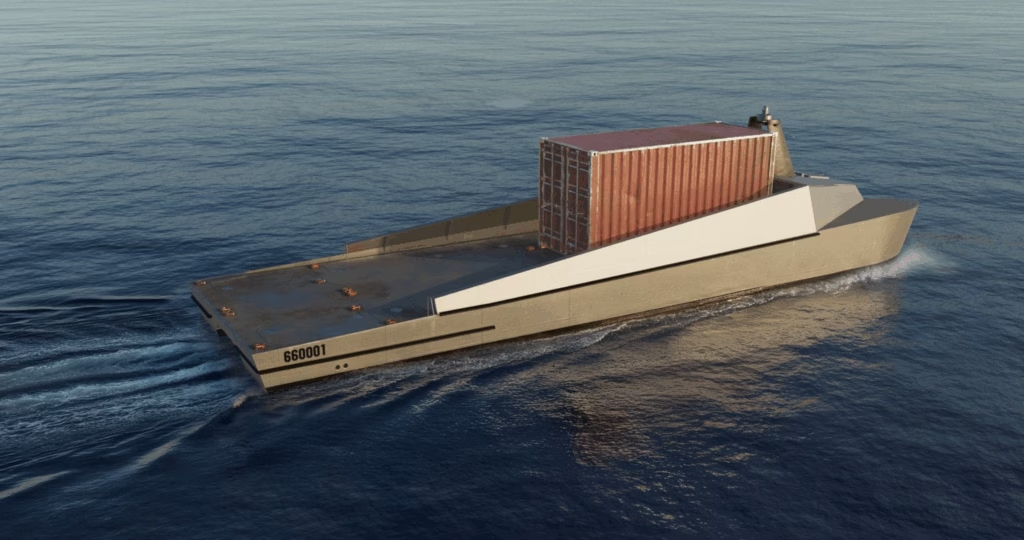
What really sets the MASC apart is its modularity. Picture a giant flat deck—900 square feet of open space—that’s been engineered to handle standard shipping containers weighing up to 30 tonnes. That’s not just a cargo trick; it’s the heart of the MASC’s design philosophy.
Instead of needing a specialized ship for every single mission, the Navy can just attach the right module onto the MASC’s deck. Need electronic warfare support? Bolt on the right container. Preparing for anti-submarine warfare? Swap in the ASW module. Want to deliver supplies across a contested zone? Attach a logistics container.
Even better, the ship’s power plant has been designed with this in mind. With the ability to crank out 198 kWe for sensors, weapons, and mission systems, the MASC has nearly double the payload power and space compared to other vessels in its class. That means more room for advanced radar, heavier weapons, or additional surveillance equipment—all depending on what the mission calls for.
This “plug-and-play” concept, enabled by the Navy’s own Unmanned Maritime Autonomy Architecture (UMAA), is what makes the MASC so appealing. It’s not just a warship. It’s potentially seven different warships in one.
A Vessel for Every Mission
So what can the MASC actually do? The answer is: quite a lot. Right now, BlackSea has designed it with seven main mission profiles in mind, each of them critical to naval operations.
It can be outfitted for Anti-Submarine Warfare, hunting down threats lurking beneath the waves. It can take on Anti-Surface Warfare, squaring off against enemy ships. It’s capable of handling electronic warfare, disrupting enemy communications and radar systems.
The MASC can also be deployed for Intelligence, Surveillance, and Reconnaissance, giving the Navy extra eyes and ears in contested waters. Logistics is another strong suit, as the vessel can ferry supplies across long distances without needing human crews. It can monitor critical maritime infrastructure, such as undersea cables and pipelines, which are increasingly becoming strategic targets. And of course, it can be configured for direct combat strikes or mine warfare, tackling some of the most dangerous jobs out there.
The beauty is that the Navy doesn’t have to build seven different ships to cover all those bases. They just need the right modules ready to go.
Built for Speed, Endurance, and Reach
For all its modular bells and whistles, the MASC is still a ship at its core. And as a ship, it’s designed to perform in real-world conditions.
Its twin-hull catamaran design isn’t just for show. The two thin hulls give it superior seakeeping abilities, meaning it can cut through rough waters while maintaining stability. That also translates into better speed and efficiency.
Powered by dual Volvo Penta D8-IPS600 integrated propulsion units, the MASC can hit a top speed of 25 knots—about 28.8 miles per hour. That might not sound like a sports car, but for a ship of its size and role, it’s plenty fast. For longer missions, it cruises comfortably at 10 knots, which allows it to stretch its legs across 3,000 nautical miles.
But here’s where it gets impressive: in self-deployment mode, the MASC can cover a staggering 10,000 nautical miles. That’s the kind of range that makes it capable of crossing oceans on its own, repositioning wherever it’s needed without requiring a carrier ship to bring it along.
Why This Matters for the Navy
You might be wondering why the U.S. Navy—or any navy for that matter—would be so interested in something like the MASC. The answer comes down to three things: flexibility, safety, and cost.
Flexibility is obvious. Instead of needing specialized fleets for every mission type, the Navy can invest in a smaller number of MASCs and then configure them as needed. It’s like having one ship that can be instantly turned into whatever the situation demands.
Safety is another big factor. Naval warfare is dangerous, and certain missions—like mine clearing or infrastructure monitoring—can put sailors at extreme risk. With an autonomous vessel, you’re keeping human lives out of harm’s way while still accomplishing the mission.
And then there’s cost. Building, crewing, and maintaining traditional warships is incredibly expensive. By contrast, an autonomous and modular ship like the MASC can deliver multiple capabilities for a fraction of the investment. That makes it not only practical but financially appealing.
The Bigger Picture
Stepping back for a moment, the MASC is more than just a single vessel design. It’s a sign of where naval technology is headed. Autonomy is no longer just a futuristic experiment—it’s becoming an integral part of military strategy.
Just as drones have completely reshaped the way we think about air combat and reconnaissance, unmanned ships like the MASC are poised to do the same for maritime operations. They can patrol vast stretches of ocean, carry out dangerous missions, and free up manned ships and crews for tasks where human judgment is irreplaceable.
There’s also the strategic advantage of unpredictability. A fleet of MASCs could be deployed with different mission modules, making it much harder for adversaries to guess what each vessel is actually capable of at any given time. That kind of ambiguity can be a powerful deterrent.
Looking Ahead
The BlackSea MASC may look futuristic today, but in many ways, it feels inevitable. As the demands on modern navies grow—whether it’s protecting shipping lanes, deterring rivals, or monitoring critical infrastructure—the need for versatile, autonomous solutions will only increase.
The Navy’s solicitation for designs in 2025 wasn’t just about experimenting. It was about preparing for a new era of naval operations, one where flexibility, autonomy, and modularity will be just as important as raw firepower.
If the MASC lives up to its promise, it could be one of the first truly transformative steps toward that future. And who knows? In a few years, seeing a fleet of these sleek, container-topped vessels patrolling the seas might feel as normal as seeing drones flying overhead today.
Final Thoughts
What makes the MASC so exciting isn’t just its technology—it’s the philosophy behind it. It represents a shift away from rigid naval traditions toward something more dynamic, adaptable, and cost-effective. It’s about building ships that can change as quickly as the threats they face.
And let’s be honest: it also just looks really cool. A minimalist, futuristic catamaran slicing through the waves, ready to transform from a reconnaissance scout to a combat strike platform at the drop of a hat—it’s hard not to be impressed.
So next time you hear about the future of naval warfare, don’t just think about aircraft carriers or submarines. Think about vessels like the MASC, quietly rewriting the rules of the game one modular container at a time.
Source: BlackSea Technologies