
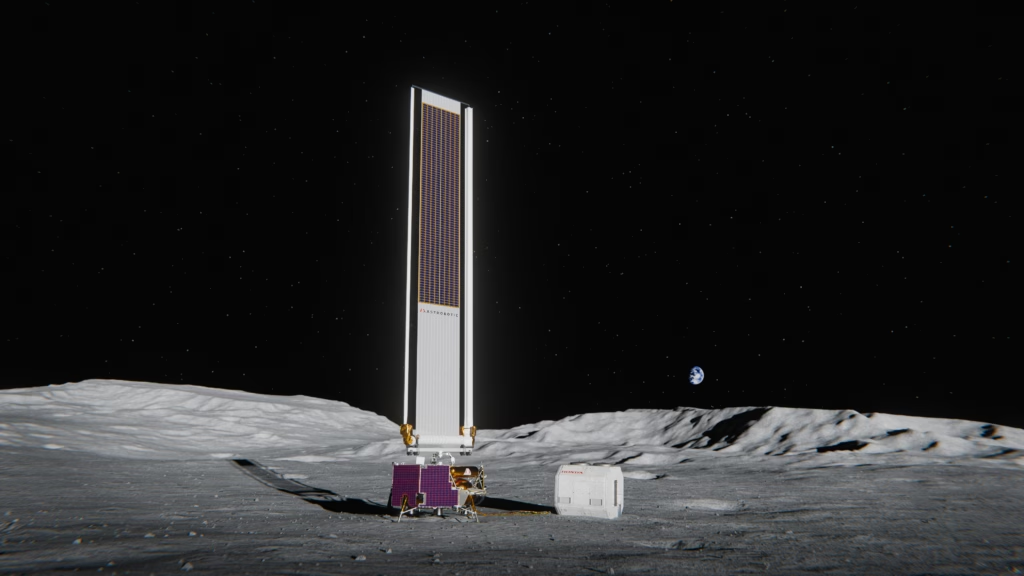
If we’re serious about exploring the Moon—or even Mars—one of the trickiest questions is this: how do astronauts get power when it’s night? Unlike Earth, where energy storage has several practical solutions, the Moon presents some unusual challenges. Honda and Astrobotic think they may have the answer, and it involves a clever use of regenerative fuel cells.
Why Nighttime Power Is Such a Challenge
Here on Earth, power generation usually comes with built-in ways to store energy for later. Take hydroelectric plants as an example. When there’s extra energy being generated, it doesn’t go to waste. Instead, the system uses that excess to pump water uphill. Later, when demand increases, the water is released back down, spinning turbines to generate electricity again. Simple, effective, and powered by gravity.
On the Moon, though, things are a lot trickier. For starters, the Moon doesn’t have rivers, lakes, or the liquid water needed for hydroelectric storage. On top of that, the gravity is only about one-sixth of Earth’s, which makes pumped storage impractical. And then there’s the biggest hurdle of all: the lunar day-night cycle. Because the Moon is tidally locked to Earth, a single “day” or “night” lasts about two weeks. Imagine trying to keep solar-powered technology running through 14 days of darkness.
Enter Honda’s Regenerative Fuel Cell
Honda has been developing something called a regenerative fuel cell, or RFC, and this is where things get interesting. Think of it as a system that stores solar energy by splitting water into hydrogen and oxygen. The hydrogen is held in reserve, and when power is needed, the system reverses the process—combining hydrogen with oxygen to produce electricity and, as a bonus, water again.
It’s essentially a cycle of creating and using hydrogen fuel, all powered by solar energy. That makes it perfectly suited for environments like the Moon, where traditional storage systems just don’t work.
Building a Power Grid for the Moon
This kind of solution isn’t just for small rovers with tiny solar panels. It’s meant for something much bigger. Astrobotic is already working on a project called LunaGrid, which is designed to provide large-scale, continuous energy on the lunar surface. By combining Honda’s RFC technology with LunaGrid’s infrastructure, future astronauts could have a steady supply of electricity—day or night.
That means rovers could recharge instead of sitting idle for two weeks, and eventually, lunar colonies could have the power they need to keep life going in one of the harshest environments imaginable.
Looking Toward the Future
It’s fascinating to think that something as simple as storing hydrogen could hold the key to powering humanity’s next great leap in space exploration. While the challenges of living and working on the Moon are enormous, innovations like Honda’s regenerative fuel cell bring us one step closer to making it possible.
The Moon may not have rivers or steady sunlight at all times, but with the right technology, we just might light up the night sky—literally.
Source: Honda