
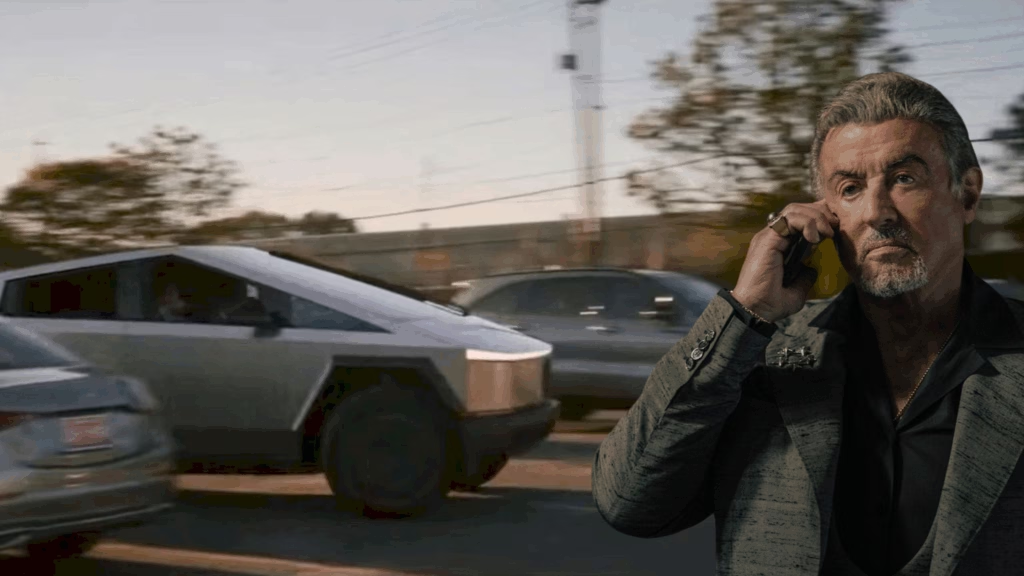
Electric vehicles are no longer just taking over the roads — they’re slowly invading pop culture. And it was only a matter of time before the most futuristic of them all, the Tesla Cybertruck, made its debut on the big screen.
Well, maybe not literally on the big screen, but figuratively, the stainless steel pickup has officially earned a sort of Hollywood recognition. The latest proof? Its starring role in the third season of Tulsa King, a crime drama television series led by none other than Sylvester Stallone.
In this particular show, the Cybertruck doesn’t just sit in the background looking shiny. Its bulletproof body becomes a literal lifesaver for one of the main characters, proving that this is more than a cameo — it’s an action-worthy role that cements Tesla’s cultural influence.
Tulsa’s Longstanding Tesla Aspirations
Before we dive into the TV drama, let’s rewind a bit. Tulsa has had a long-standing love affair with Tesla — or at least, an aspirational one. Back in 2020, the Oklahoma city tried to compete with Austin, Texas, to host Elon Musk’s next gigafactory. The effort was ambitious, creative, and maybe just a little audacious: Tulsa even transformed its iconic Golden Driller statue into a monument celebrating Elon Musk. That’s right, the city literally paid homage to the billionaire.
Alas, Austin won the gigafactory bid, and Tulsa’s dreams of a local Tesla manufacturing hub were put on hold. But all wasn’t lost. Tulsa eventually got a piece of Tesla magic, albeit through the lens of television. In a way, it’s a symbolic win: the Cybertruck finally rolls through the city, even if only on screen, connecting Tulsa to the world of EV innovation.
Cybertruck’s Big Screen Debut in Tulsa King
Tulsa King Season 3 brings together a cast of heavy-hitters, including Sylvester Stallone, who plays the larger-than-life crime boss, Dwight “The General” Manfredi. The show is a classic crime drama, filled with guns, fast getaways, and larger-than-life personalities. Naturally, it also needs vehicles that match the larger-than-life aesthetic.
Enter the Tesla Cybertruck. But before the Cybertruck steals the spotlight, the show introduces another electric vehicle — a “grasshopper-green” Hyundai Ioniq 5. Let’s just say it doesn’t exactly impress. Its color alone makes it look comically out of place in a gangster drama, almost like a highlighter on wheels. The Ioniq 5, in this case, serves as the opening act, setting the stage for the real star: the angular, metallic, undeniably futuristic Cybertruck.
The green Hyundai is not treated gently. Stallone’s character and the show’s tone lean into every anti-EV stereotype: slow speeds, limited range, and long charging times are all mocked for dramatic effect. The Ioniq 5 is played for laughs. But the Cybertruck, when it finally appears, is presented in a much more heroic light — though the script still has fun with its unusual appearance.
The “Gangster’s Ride” Moment
There’s a memorable line that perfectly captures the Cybertruck’s TV persona. Tyson Mitchell, played by Jay Will, says of the truck: “It’s bulletproof, man. This how a gangster’s supposed to roll.” The humor and irony come immediately after, when Bodhi, portrayed by Martin Starr, deadpans: “Yeah, in Blade Runner. Real life, we don’t drive around in a refrigerator.”
It’s funny, self-aware, and quintessentially Tesla — larger-than-life claims that toe the line between reality and science fiction. But as the plot unfolds, the Cybertruck’s bulletproof abilities are put to the test. In a tense moment, the tailgate actually stops bullets fired at Tyson Mitchell, saving his life. For a few brief seconds, the fantasy of a real-life, futuristic armored vehicle becomes a reality on screen.
Separating Movie Magic From Reality
Of course, anyone familiar with Tesla knows that not everything in Tulsa King is 100% accurate. The Cybertruck, for instance, made headlines back in 2023 during its launch event when Elon Musk famously had a demonstration go slightly awry. The idea of a “bulletproof” truck has always been a bit of a marketing stunt, meant to showcase the strength of its stainless steel exoskeleton.
Here’s the reality: the doors are reinforced and thicker than the rest of the panels, which allows them to withstand higher-caliber bullets. Meanwhile, the sail panels — the flat surfaces on the truck bed sides — are made of slightly thinner steel. While they might not stop rifle rounds, they can still handle small-caliber bullets, like the ones fired in the Tulsa King scene.
Wes Morrill, the Tesla Cybertruck’s lead engineer, confirmed as much on social media when the show aired. “[The] tailgate is 1.4mm thick HFS, which is the same as the sail panel. In our demo video, the sail does stop Tommy gun bullets. The doors have more stopping power at 1.8mm thick,” Morrill wrote.
It’s a subtle distinction but an important one: Tesla knows exactly which parts of the truck are bulletproof and which aren’t, making the TV portrayal plausible without straying too far from reality.
The Star That Markets Itself
What’s interesting about this appearance is that it’s arguably the closest Tesla has ever come to traditional advertising. The company notoriously avoids conventional marketing — no flashy Super Bowl ads, no paid commercials. Tesla’s approach has always been to let its products speak for themselves, often through stunts, viral videos, or word-of-mouth buzz.
And yet, here’s the Cybertruck, featured in a prime-time TV show, demonstrating one of its most talked-about attributes: bulletproof exteriors. Whether intentional or not, it’s a masterstroke of brand reinforcement. Even if most viewers aren’t buying a “gangster-grade” EV, they’re seeing a futuristic Tesla that stands out, that’s tough, and that’s different from anything else on the road.
Some fans have speculated whether Elon Musk had a hand in this cameo. The episode seems to have been filmed during a period when Musk’s political and social alignment with certain Hollywood circles was more pronounced. While it’s impossible to say for sure, the timing and placement certainly suggest that Tesla benefited from some strategic visibility.
A Growing Trend
The Cybertruck in Tulsa King isn’t Tesla’s first brush with pop culture, and it won’t be the last. Electric vehicles, in general, are slowly becoming mainstream in media, reflecting their growing presence in the real world. Cars like the Hyundai Ioniq 5, the Nissan Leaf, and even high-end EVs from Lucid and Rivian are beginning to appear in TV shows and movies, sometimes as comic relief, sometimes as aspirational symbols.
But the Cybertruck’s appearance is notable because it’s more than just a background prop. It has a narrative purpose, helping to protect a character and moving the plot forward. That’s a step beyond mere product placement — it’s a way of embedding an EV into the cultural imagination, making viewers see it as something heroic, not just environmentally friendly.
Why the Cybertruck Works On Screen
So why does the Cybertruck look so at home in a crime drama, while other EVs are laughed at? Part of it is its design. The angular, stainless steel exoskeleton gives it a cinematic presence that feels futuristic and almost indestructible. It’s visually striking in a way that most modern cars — especially sleek, curvy EV sedans — are not.
Then there’s the “storytelling potential.” In Tulsa King, the truck’s bulletproof features are integral to the scene. It’s not just a car you drive; it’s a tool, a shield, a plot device. That’s a rare narrative opportunity for an EV — one that gas-powered trucks have enjoyed for decades in action films, but for EVs, it’s a novelty.
Finally, there’s the cultural cachet. Tesla has become synonymous with innovation, futurism, and a certain aspirational edge. Featuring a Tesla on a TV show signals modernity and technological sophistication, even if the storyline exaggerates its capabilities.
The Legacy of the Cybertruck
When the Cybertruck launched in 2023, reactions were mixed. Some people mocked it, calling it a “refrigerator on wheels,” while others hailed it as a visionary leap in automotive design. That duality continues in its pop culture life. The truck is simultaneously ridiculous and remarkable, practical and fantastical, making it perfect for a show like Tulsa King.
Its on-screen exploits — stopping bullets, saving characters, looking undeniably futuristic — reinforce the legend of the Cybertruck without Tesla having to spend a dime on traditional advertising. For fans of the brand, it’s a thrill. For casual viewers, it’s a memorable vehicle that stands out from all the bland cars they see on TV every day.
A Subtle Victory for Tesla and Tulsa
In a way, the Cybertruck’s TV appearance is a win-win. Tulsa gets a moment of recognition in the world of pop culture, even if it didn’t land a gigafactory. Tesla gets to show off one of its most ambitious vehicles in action, proving that it’s capable of more than just commuting in the real world.
And for viewers, it’s entertaining. You get the humor of the green Ioniq 5, the drama of the bulletproof Cybertruck, and a story that feels slightly larger-than-life — all while subtly reminding everyone that EVs are part of our cultural zeitgeist.
EVs Aren’t Just Cars Anymore
The Cybertruck in Tulsa King is more than a cameo; it’s a cultural statement. Electric vehicles are no longer niche tech experiments or environmental talking points. They are becoming iconic, memorable, and even heroic — capable of saving lives, or at least looking like they could.
Tesla’s approach — letting the truck speak for itself, even in a fictional world — is emblematic of the brand’s marketing philosophy. And while most of us won’t be dodging bullets in a Cybertruck anytime soon, seeing it on screen gives a taste of the boldness, the innovation, and the spectacle that Tesla represents.
The next time you watch a show, keep an eye out for EVs. You might just see the future of transportation — or at least a glimpse of a truck that looks like it could survive a small apocalypse — rolling across your TV screen.