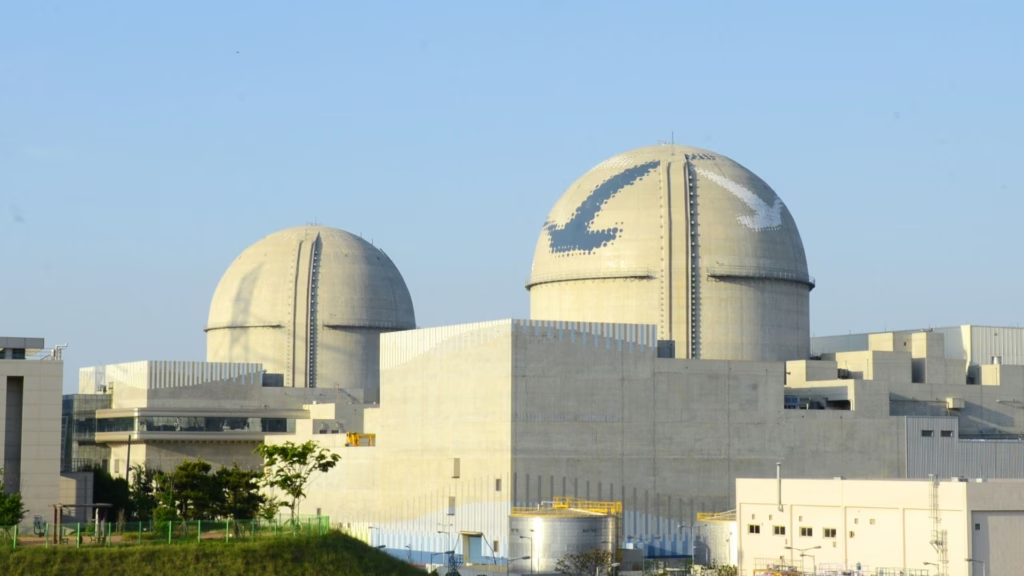
South Korea has just taken a big step forward with its next-generation nuclear power program, and things are getting pretty exciting. The Saeul Unit 3 reactor is now much closer to going live, after passing a series of important safety checks. The country’s Nuclear Safety and Security Commission confirmed that everything required before the reactor’s first criticality has been completed. This stage is a major turning point because it means the reactor is ready to safely start a sustained nuclear chain reaction, which is essential for generating power.
So what does that really mean? Essentially, the project is moving out of the construction and testing phase and into active operation territory. Before reaching this point, regulators carried out detailed inspections across five stages, focusing on everything that needs to be in place before the reactor goes critical. This included checking how nuclear fuel was loaded, running high-temperature tests, and making sure all equipment performs exactly as expected under real-world conditions. After reviewing everything, officials confirmed that the reactor can safely achieve criticality.
They didn’t just stop at a few checks either. A total of nine mandatory inspections were completed before reaching this stage. These are designed to ensure the reactor can maintain a stable fission process, where neutron production and loss are balanced. In simple terms, it’s about making sure the reactor can run steadily and safely without unexpected fluctuations.
The journey to get here hasn’t been smooth. Saeul Units 3 and 4 are based on South Korea’s APR1400 reactor design, and the project has been in the works for over a decade. It was first approved back in 2014, when the units were still known as Shin Kori 5 and 6. Construction officially began in 2017, but not without setbacks. There was even a temporary halt due to a change in government, which led to a public debate about whether to continue. In the end, nearly 60 percent of the public supported moving forward, mainly because of concerns about maintaining a stable power supply.
Since then, work has steadily progressed. Unit 4 followed with construction starting in 2018, although both units missed their original timelines. Now, the focus is back on moving ahead, with Unit 3 expected to begin commercial operations around August 2026, and Unit 4 likely coming online later the same year.
Even though this milestone is a big deal, there’s still more testing ahead. Once the reactor reaches criticality, regulators will carry out power ascension tests, gradually increasing output while closely monitoring performance. In total, 31 additional inspections are planned before the reactor officially enters commercial service. These tests will also include checking emergency response systems to make sure the plant can handle any unexpected situations just like fully operational nuclear facilities.
When everything is up and running, Saeul Unit 3 is expected to contribute around 1.7 percent of South Korea’s total electricity. It will also play a major role locally, supplying about 37 percent of the energy demand in the Ulsan region. That’s a significant boost for both national and regional power stability.
This project is also part of a bigger picture. South Korea has been expanding its APR1400 reactor fleet, and it’s even exporting this technology internationally, including successful projects in the United Arab Emirates. The progress at Saeul shows how the country is pushing forward with nuclear energy while keeping a strong focus on safety and reliability.