
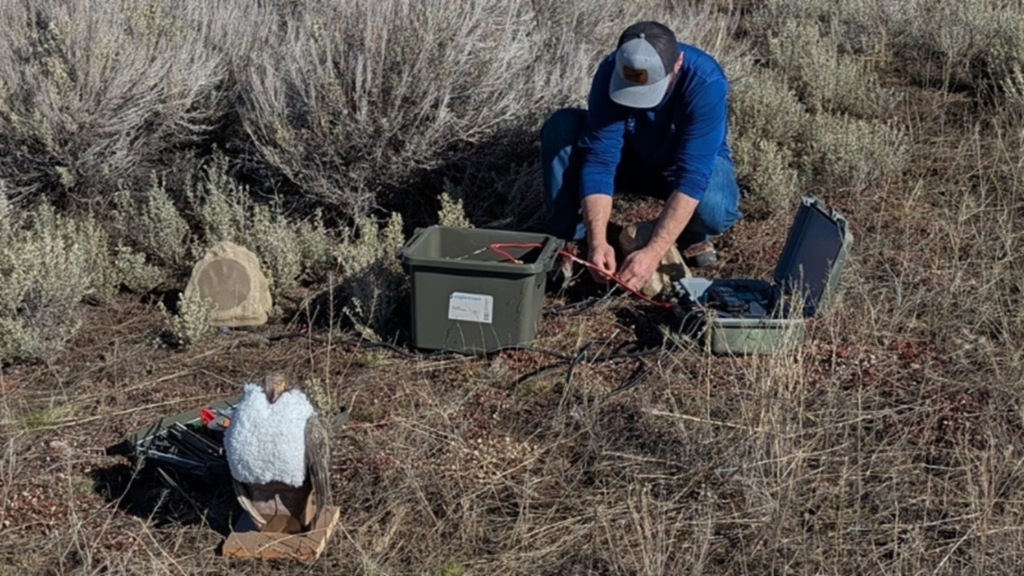
Robotic bird decoys are now being used in Grand Teton National Park to help guide the behavior of real sage grouse and support their declining population. These lifelike replicas are designed with motion and sound to mimic natural mating rituals, encouraging birds to return to safer breeding areas. It’s a creative approach aimed at addressing a serious issue, as sage grouse numbers across the American West have dropped significantly over the years.
At one breeding site in Jackson Hole, the decline has been especially dramatic, with male counts falling from dozens in the mid-20th century to just a handful recently. To better understand and respond to this trend, wildlife experts are combining these robotic decoys with advanced data tools that track annual breeding activity and compare it with historical patterns. This allows conservation teams to monitor changes more closely and make smarter decisions about where to focus their efforts.
The project is also tied to a broader habitat restoration effort near Jackson Hole Airport, which sits uniquely inside a national park. Over time, aircraft activity has posed risks to the birds, with multiple collisions reported. By encouraging sage grouse to shift their breeding activity away from these high-risk areas, the decoys could help protect both wildlife and aviation operations.
These robotic birds are built using a mix of real feathers and simple materials like foam and fabric. Some are stationary, while others are motorized to recreate the movements seen during mating displays. They’re programmed to perform repetitive sequences that imitate lekking, a courtship behavior where male grouse gather and display to attract females. Paired with recorded mating calls, the decoys create the impression of an active breeding ground, which can trigger real birds to join in.
The idea behind this approach is to spark natural behavior in places where it has faded. By drawing adult birds into restored habitats, conservationists hope they will begin nesting there, allowing future generations to grow in safer conditions. Since chicks are raised close to these breeding sites, even small shifts in adult behavior could have a long-term impact on population recovery.
This project also stands out for its collaborative and accessible design. Local students and robotics teams have contributed to building and refining the decoys, keeping costs low while encouraging innovation. The devices are modular and can be deployed strategically across different habitat zones, making them adaptable for other conservation efforts as well.
So far, around 100 acres of land have been restored to create suitable habitat, but attracting wildlife back has proven challenging. That’s where these robotic decoys come in, helping bridge the gap between habitat restoration and actual animal return. Cameras are now monitoring how real birds respond during the current breeding season, offering valuable insights into whether this method is working.
If the results are positive, this could open the door for similar techniques in other conservation projects where animals don’t immediately return to restored environments. It’s a fascinating example of how technology and ecology can work together to solve complex environmental challenges in a practical and innovative way.