
This is one of those breakthroughs that sounds super technical at first, but it could completely change how scientists study antimatter. Researchers in Germany have taken a big step toward creating antihydrogen by figuring out how to trap two very different types of particles in the same place at the same time. That’s something scientists have struggled with for years.
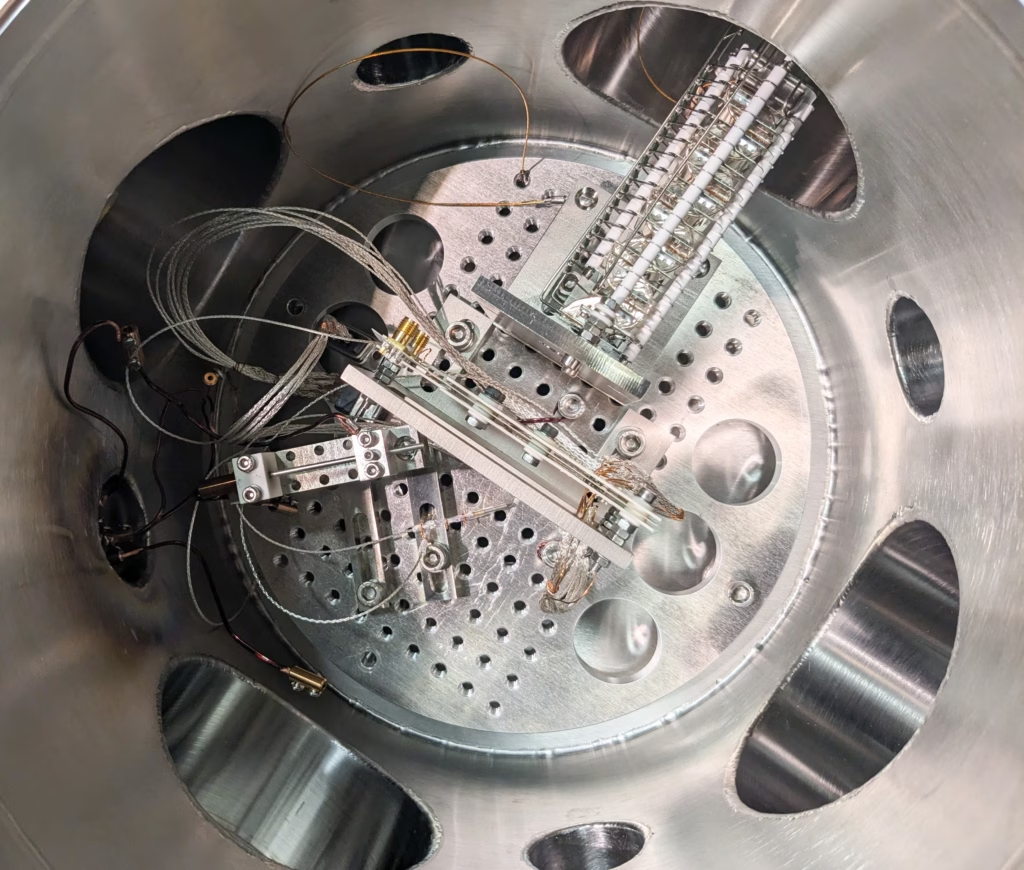
The team, led by Dmitry Budker at Johannes Gutenberg University Mainz, built a special kind of particle trap that works on two different frequencies at once. Normally, these traps—called Paul traps—can only operate at a single frequency, which means they’re limited to holding just one type of particle at a time. That’s a huge limitation when you’re trying to combine particles that behave very differently.
To understand why this matters, creating antihydrogen requires bringing together antiprotons and positrons. These particles don’t play nicely under the same conditions. Positrons are extremely light and need very high-frequency electric fields to stay stable, while antiprotons are much heavier and require much lower frequencies. Until now, that mismatch has made it incredibly difficult to trap both at once.
So instead of jumping straight to antimatter, the researchers used stand-ins: electrons to mimic positrons and heavy calcium ions to represent antiprotons. Then they designed a clever device made of layered circuit boards. One part of the setup generates high-frequency fields to hold the electrons, while other sections produce lower-frequency fields to trap the heavier ions. It’s like building a system that can handle both a hummingbird and a bowling ball at the same time.
They were able to trap each type of particle successfully, which is already impressive. But getting both to stay stable together in the same trap turned out to be much harder. Electrons are especially sensitive to the lower-frequency fields used for ions, and even small changes can cause them to escape. On top of that, tiny imperfections in the device—like surface roughness or slight misalignments—can reduce how well the trap works.
Even with those challenges, this is a major step forward. The ultimate goal is to use this dual-frequency trap to combine antiprotons and positrons into antihydrogen outside of massive facilities like CERN, which is currently the only place that can produce and study it in significant amounts.
Antihydrogen is often described as the “holy grail” of antimatter research because of its simplicity—just one antiproton and one positron. That simplicity makes it perfect for testing some of the biggest questions in physics, like why the universe is made mostly of matter instead of antimatter.
And there’s more. This technology could also open the door to entirely new experiments. For example, scientists have long predicted that positrons might briefly bind to ordinary atoms, but no one has been able to test that idea directly. With this kind of trap, that could finally become possible.
So while there’s still work to be done, this breakthrough brings us a lot closer to studying antimatter in ways that were once only possible in a handful of specialized labs. And that could lead to some pretty fundamental discoveries about how our universe actually works.