
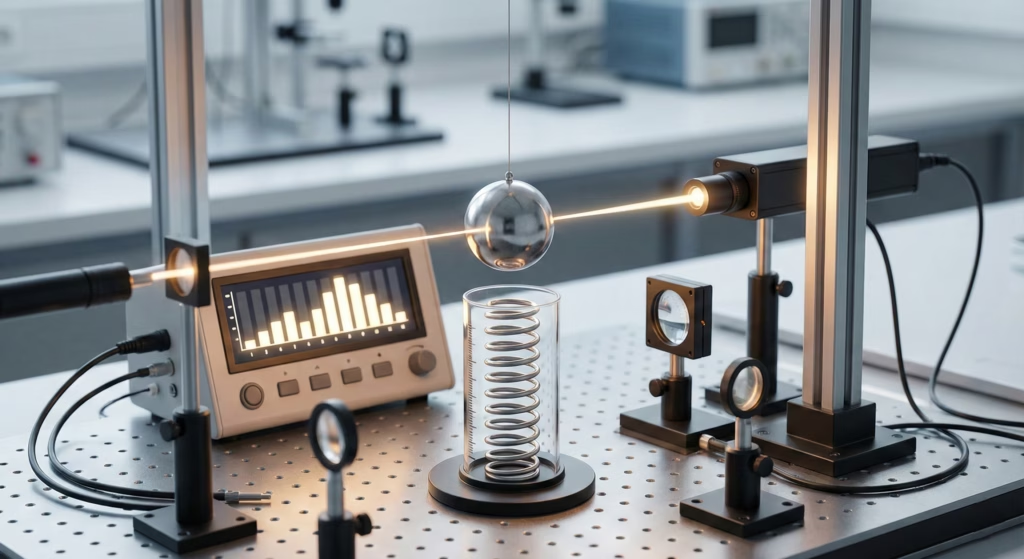
Energy is one of those words we use every day. We talk about having energy, saving energy, or running out of energy. In physics, though, energy has a very specific meaning and a very careful way of being measured. Once you understand how scientists measure energy, the whole idea becomes less mysterious and much more interesting. Think of it as learning the language energy uses to tell its story.
What Energy Really Means
In physics, energy is the ability to do work or cause change. That might sound abstract at first, so imagine pushing a heavy box across the floor. The motion of the box is a change, and the effort you use to make it move is energy. Light warming your skin, food fueling your body, and electricity powering your phone all involve energy doing something noticeable.
Because energy shows up in so many forms, scientists needed a common way to measure it. Without a shared unit, comparing different kinds of energy would be like comparing apples to clouds.
The Joule as the Main Unit of Energy
The standard unit of energy in physics is called the joule. It is named after James Prescott Joule, a scientist who studied the connection between heat and motion. A joule is a small amount of energy, which makes it perfect for scientific measurements.
One simple way to picture a joule is this. If you lift a small apple about one meter off the ground, you are using roughly one joule of energy. It is not an exact example, but it gives you a feel for the scale. When scientists talk about thousands or millions of joules, they are describing much larger energy changes.
Energy and Work Go Hand in Hand
To understand how energy is measured, it helps to know how work is measured. In physics, work happens when a force moves an object in the direction of that force. The amount of work done depends on how strong the force is and how far the object moves.
Work is measured in joules as well. This is not a coincidence. Energy and work are closely linked. When you do work on something, you transfer energy to it. Measuring the work done gives scientists a clear way to measure the energy involved.
Kinetic Energy and Motion
Kinetic energy is the energy of motion. Anything that moves has kinetic energy, from a rolling ball to a speeding car. The faster something moves and the more mass it has, the more kinetic energy it carries.
Physicists calculate kinetic energy using the object’s mass and speed. The result comes out in joules. This lets scientists compare motion in a precise way. A bicycle rolling down the street has far less kinetic energy than a train moving at high speed, even if both feel fast to the human eye.
Potential Energy and Stored Energy
Not all energy is about motion. Potential energy is stored energy, waiting to be used. A book resting on a high shelf has gravitational potential energy because it could fall. A stretched rubber band has elastic potential energy because it can snap back into shape.
Potential energy is also measured in joules. The height of the object, its mass, and the strength of gravity all play a role. Measuring potential energy helps physicists predict what will happen when that stored energy is released.
Heat and Thermal Energy
Heat is another form of energy that often feels less concrete. Thermal energy comes from the motion of tiny particles inside matter. The warmer something is, the more those particles move.
Thermal energy is measured in joules too, although you might also hear about temperature units like degrees Celsius. Temperature tells you how hot or cold something is, while energy measurements tell you how much thermal energy is actually present. A bathtub of warm water contains far more thermal energy than a cup of boiling water, even though the cup is hotter.
Electrical Energy and Everyday Life
Electrical energy powers much of the modern world. In physics, electrical energy is still measured in joules, but in daily life you often see a larger unit called the kilowatt hour. This unit is useful because electrical devices usually involve large amounts of energy over time.
Behind the scenes, the kilowatt hour can be converted into joules. Scientists do this when they want everything in the same unit. It keeps calculations consistent and comparisons fair.
Why Measuring Energy Matters
Measuring energy is not just an academic exercise. It helps engineers design safer cars, more efficient engines, and better renewable energy systems. It helps scientists understand how stars shine and how the universe evolves. Even athletes and nutrition experts rely on energy measurements when talking about performance and food.
When energy can be measured clearly, it becomes something we can manage, predict, and improve.
Bringing It All Together
Energy in physics is measured to make sense of change, motion, and possibility. The joule acts as a common language that connects moving objects, stored forces, heat, and electricity. Once you see energy through this lens, the world feels a little more connected. Every push, glow, spark, and heartbeat becomes part of the same story, all measured in the same simple unit.