
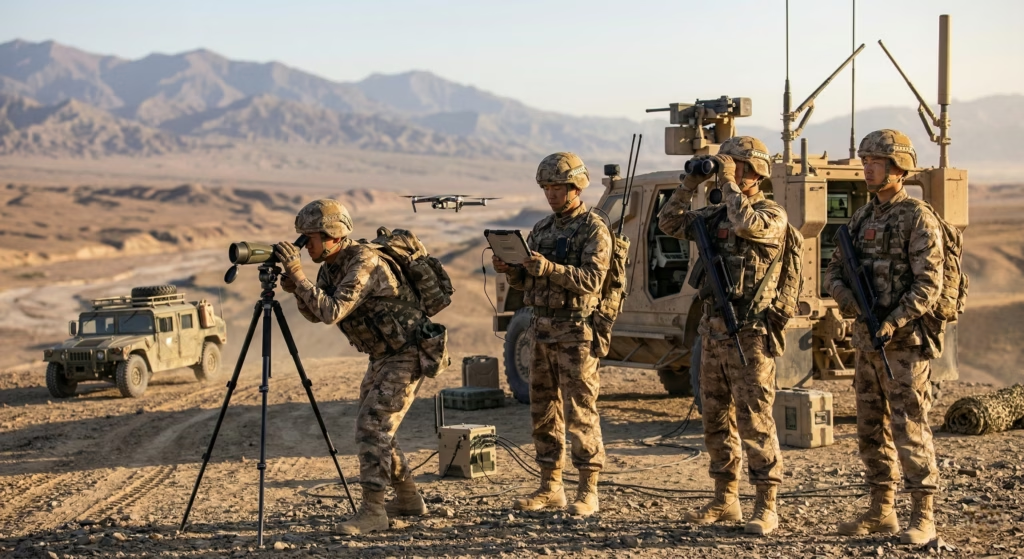
China is making a big push into military AI, and one of its latest developments is something being described as a “digital chief of staff.” This system, reportedly built by the People’s Liberation Army and the National University of Defense Technology, is designed to support battlefield commanders by handling complex decisions in real time.
In simulated amphibious assault scenarios, this AI showed some impressive results. It made decisions 43 percent faster than experienced human commanders and kept communication accuracy above 90 percent even when electronic jamming was in play. That’s a big deal because jamming is meant to create confusion, yet the AI still managed to stay sharp and reliable.
What makes this system stand out is how it processes information. It combines large language models with live battlefield data, helping commanders cut through the chaos. Instead of getting overwhelmed with noise, the AI highlights the most critical threats and points out gaps in knowledge that could affect the mission. It focuses on identifying what the military calls “critical information requirements,” basically the unknowns that could decide whether an operation succeeds or fails.
To really test its capabilities, researchers put the AI up against a group of seasoned military experts with years of experience in amphibious warfare. The simulation involved a high-pressure beachhead invasion, where troops and armored units push inland under intense conditions. In this environment, the AI acted as a steady operational guide, helping maintain order while everything else was in motion.
One of its biggest advantages is how it speeds up the decision-making cycle, often referred to as the OODA loop, which stands for observe, orient, decide, and act. While human commanders were still analyzing the situation, the AI had already moved ahead with recommendations, effectively tightening that loop and enabling faster responses on the battlefield.
Even when communications were heavily disrupted, the system retained a strong memory of key information, maintaining over 90 percent accuracy. It also showed an ability to detect what wasn’t immediately visible. In one case during the simulation, it noticed that while enemy forces were advancing, their reserves were missing. That absence signaled a potential ambush, and the AI quickly suggested deploying reconnaissance units to investigate, something that might take human teams much longer to conclude.
Another important detail is that the AI doesn’t just make random suggestions. Its recommendations are aligned with established military protocols, meaning it operates within known strategic frameworks rather than going off-script. This makes it more practical for integration into real command structures.
That said, the system isn’t perfect yet. Researchers have pointed out a “cold start” problem, meaning if a commander doesn’t have a history of recorded decisions, the AI lacks a baseline to adapt to their style. It’s also currently specialized, mainly trained for coastal and amphibious operations, and hasn’t been fully tested in environments like dense urban combat or mountainous terrain.
Looking ahead, developments like this suggest a future where AI could act as a smart battlefield assistant, coordinating multiple units and handling massive amounts of data in ways humans simply can’t match alone. This is all part of a larger global race to integrate advanced technology into military operations, especially as competition between major powers continues to intensify.