
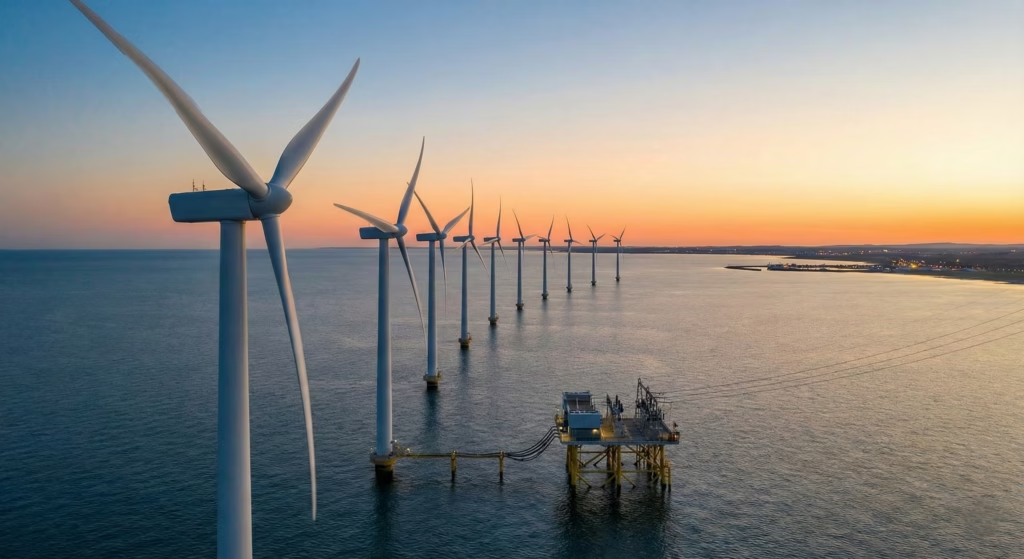
Have you ever stood outside on a windy day and felt the air push against your face? That invisible force is packed with energy. Wind turbines are clever machines that know how to catch that energy and turn it into electricity that lights homes, powers schools, and charges devices. Even though they look tall and complex, the idea behind them is surprisingly simple. This article walks you through how wind turbines generate power in a friendly, story driven way that feels more like a conversation than a science lecture.
By the end, you will understand what happens from the moment wind touches a blade to the instant electricity flows into the grid. You do not need a background in engineering or physics. Curiosity is enough.
The simple idea behind wind power
At its heart, wind power is about motion. Moving air has energy because it is moving. When that moving air pushes against something, it can make that thing move too. People have known this for centuries. Sailboats glide across water because wind pushes their sails. Old windmills turned large wheels to grind grain because wind pushed their wooden blades.
A modern wind turbine follows the same basic idea. Wind pushes the blades. The blades spin. That spinning motion is carried inside the turbine and converted into electricity. The machine does not create energy from nothing. It simply changes the form of energy from moving air into electrical energy that we can use.
A short history of wind machines
Long before electricity, people learned to work with the wind. Ancient windmills appeared in parts of the Middle East and Asia over a thousand years ago. These early machines helped pump water and grind crops. In Europe, windmills became a familiar sight, especially in flat, windy regions.
When electricity entered the picture in the late nineteenth century, inventors began experimenting with wind driven generators. Early designs were small and simple. Over time, engineers learned how to make blades more efficient and generators more reliable. Modern wind turbines are the result of decades of learning, testing, and improvement, all focused on one goal. Capture as much energy from the wind as possible while keeping the system safe and dependable.
Anatomy of a wind turbine
A wind turbine might look like a giant fan on a stick, but each part has a specific job. The most visible parts are the blades, the tower, and the housing at the top called the nacelle. Inside that housing is where much of the magic happens.
The tower lifts the turbine high into the air where winds are stronger and more consistent. The nacelle holds the mechanical and electrical components. The blades catch the wind and start the process. Every piece is designed to work together smoothly, like musicians in an orchestra.
Blades and the science of lift
Wind turbine blades are not flat like a sheet of paper. They are shaped more like airplane wings. This shape is important because it creates lift. When wind flows over the curved surface of the blade, air moves faster on one side than the other. This difference in speed creates a pressure difference that pulls the blade around in a circle.
As the wind speed increases, the blades spin faster. Engineers carefully design blade length, shape, and angle to balance power and safety. Longer blades can capture more wind, but they also feel stronger forces. Modern blades are made from strong, lightweight materials that can handle years of constant motion.
The role of the nacelle
The nacelle sits at the top of the tower behind the blades. It acts like a protective shell for the turbine’s inner workings. Inside, you will find shafts, gears, a generator, and control systems. The blades connect to a main shaft that turns when the blades spin.
Some turbines use a gearbox to increase the speed of rotation before it reaches the generator. Others skip the gearbox and use a different type of generator that works well at slower speeds. Both approaches aim to do the same thing. Turn mechanical motion into electrical power efficiently.
Towers and foundations
The tower does more than just hold the turbine up. It must support enormous weight and withstand strong winds, storms, and even earthquakes in some locations. Towers are usually made from steel or concrete and are anchored deep into the ground.
Height matters because wind tends to be stronger and steadier higher up. By placing turbines on tall towers, engineers give them access to better wind conditions. This means more consistent power generation over time.
From rotation to electricity
Once the blades spin, the real transformation begins. The rotating shaft inside the nacelle connects to the generator. A generator works by using magnets and coils of wire. When the shaft turns, it causes magnetic fields to move past the coils. This movement pushes electrons through the wire, creating an electric current.
This basic principle is the same one used in power plants that run on water, steam, or fuel. The difference is what causes the rotation. In a wind turbine, the wind is the driving force.
Generators explained simply
Think of a generator as a translator. It takes spinning motion and translates it into electricity. Inside, magnets create a magnetic field. Coils of wire sit nearby. As the magnets move relative to the coils, electricity flows.
The faster the rotation, the more electricity can be produced, up to the turbine’s rated capacity. Control systems make sure the generator produces electricity at the right voltage and frequency so it can safely connect to the power grid.
Power electronics and the grid
Electricity from a wind turbine does not go straight to your home. First, it passes through power electronics that clean and adjust it. These systems make sure the electricity matches the grid in terms of timing and strength.
After that, transformers step up the voltage so the electricity can travel long distances with less loss. From there, it joins the grid, mixing with electricity from other sources like solar, water, or traditional power plants. When you flip a switch, you are using a blend of energy from many places, possibly including the wind blowing miles away.
How turbines start and stop
Wind turbines do not spin all the time. They need a minimum wind speed to start producing power. When the wind is too gentle, the blades remain still. As the wind picks up and reaches a useful level, the turbine begins to turn and generate electricity.
There is also an upper limit. If the wind becomes too strong, the turbine shuts itself down to avoid damage. Blades can change their angle to reduce how much wind they catch, and brakes can stop the rotation entirely. These safety systems protect the turbine and ensure a long working life.
Life on a wind farm
A single wind turbine can produce a significant amount of electricity, but turbines often work together in groups called wind farms. These farms are carefully planned so turbines do not block each other’s wind. Spacing and layout matter.
Technicians regularly inspect turbines to keep them running smoothly. Sensors inside the nacelle monitor temperature, vibration, and performance. Many issues can be detected early and fixed before they become serious problems. This blend of technology and human care keeps wind farms reliable.
Onshore and offshore wind
Wind turbines can be found on land and at sea. On land, they are often placed on ridges, plains, or open areas with steady winds. Offshore turbines sit in the ocean, where winds tend to be stronger and more consistent.
Building at sea is more challenging and costly, but the payoff can be higher energy production. Offshore turbines are often larger because transporting big components by ship is easier than moving them over land.
Environmental impact and benefits
Wind power is considered clean because it does not release pollution while generating electricity. Turbines do not burn fuel or produce smoke. They also use very little water compared to many other power sources.
There are environmental considerations, such as how turbines affect landscapes and wildlife. Careful planning and modern designs help reduce these impacts. Overall, wind energy plays an important role in reducing greenhouse gas emissions and supporting a healthier planet.
Efficiency and capacity
Not every gust of wind becomes electricity. There are physical limits to how much energy a turbine can capture. Engineers talk about capacity factor, which describes how much electricity a turbine produces compared to its maximum possible output over time.
Wind does not blow at the same speed all day, every day. Even so, modern turbines are remarkably efficient at capturing available energy. Improvements in design continue to raise their performance year after year.
Common myths about wind turbines
Some people believe wind turbines are noisy or unreliable. In reality, modern turbines are much quieter than older designs, and at a distance they often blend into background sounds. Others worry that wind power cannot be depended on. While wind varies, combining wind with other energy sources and using smart grids makes the overall system stable.
Another myth is that turbines consume more energy to build than they ever produce. Studies have shown that turbines typically generate the energy used in their construction within a short time, then produce clean power for decades.
The future of wind energy
Wind technology continues to evolve. Blades are getting longer, materials are improving, and digital controls are becoming smarter. Floating offshore turbines may open up new areas with strong winds that were previously unreachable.
As energy storage improves, wind power will become even more flexible. Batteries and other storage systems can save excess electricity for calm periods. This makes wind an even stronger partner in a clean energy future.
Why understanding wind power matters
Knowing how wind turbines generate power helps demystify a technology you see every day. Those tall towers spinning on the horizon are not just symbols. They are working machines quietly turning nature’s movement into something useful.
Understanding the process also helps you appreciate the creativity and effort behind renewable energy. It shows how simple ideas, like letting wind push a blade, can grow into solutions that power entire communities.
Conclusion
Wind turbines generate power by doing something beautifully straightforward. They let the wind do what it naturally wants to do, which is move. Blades catch that movement. Shafts and generators guide it. Electronics refine it. The result is electricity that flows into the grid and into your life.
Next time you see a wind turbine turning slowly against the sky, you will know the story behind it. You will know how invisible air becomes visible power, and how a simple push of wind helps light the world.