
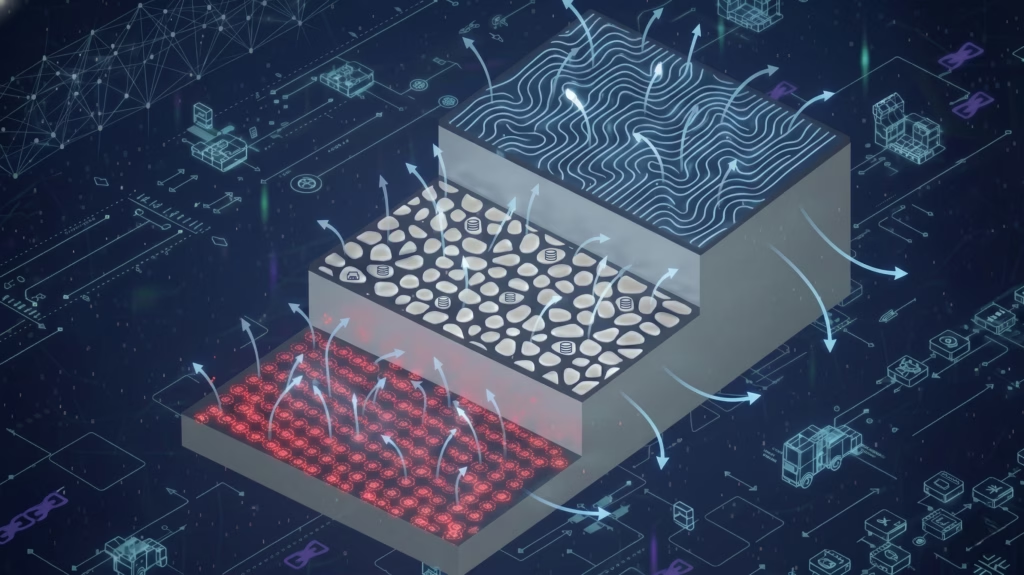
You’re looking at a major step forward in how future electronics could work, and it all comes down to something incredibly small—electron spin. Researchers at Argonne National Laboratory are diving deep into spintronics, a technology that doesn’t rely on electric charge like today’s devices, but instead uses the spin of electrons to store and process information much more efficiently.
As data demands continue to skyrocket, especially with AI and advanced computing, traditional electronics are starting to hit their limits. That’s where spintronics starts to shine. By using the tiny magnetic fields created by electron spin, scientists can encode data at an extremely small scale, opening the door to faster and more energy-efficient devices.
The team focused on ultrathin materials known as van der Waals magnets, which can be just a few atomic layers thick. These materials are especially exciting because they allow precise control over magnetic states. What researchers found is that even slight changes in thickness can significantly affect how magnetic regions—called domains—form, shift, and respond to external forces. This kind of control is crucial if we want to build smaller and more powerful electronics.
To explore this further, the scientists worked with a material called Fe3GeTe2, a promising candidate for spintronic applications. They cooled it down to extremely low temperatures using liquid nitrogen to maintain its magnetic properties. By applying a magnetic field during this process, they were able to create and manipulate specific magnetic patterns, essentially controlling how information could be stored at the nanoscale.
What makes this even more interesting is how they observed these changes. Using an advanced imaging method called cryogenic Lorentz Transmission Electron Microscopy, the team could actually watch how magnetic structures evolve in real time within a single tiny flake of the material. This gave them a direct look at how electron spins organize themselves, something that was previously only understood in a more general way.
One of the most exciting discoveries involves structures called skyrmions. These are tiny, stable whirlpools of magnetic spins that can be moved using very little energy. Because of their size and efficiency, skyrmions could play a huge role in building ultra-dense memory and low-power computing systems. The study showed that both the thickness of the material and the applied magnetic field directly affect how these skyrmions form and behave.
To back up their findings, the researchers also ran detailed simulations that closely matched what they observed in the lab. This combination of real-world experiments and modeling gives scientists a powerful way to predict and control magnetic behavior in these materials.
All of this brings us closer to a future where devices are not just smaller and faster, but also far more energy-efficient. With better control over magnetic domains and skyrmions, engineers could eventually build entirely new types of memory and processors that go far beyond what current technology can achieve.