
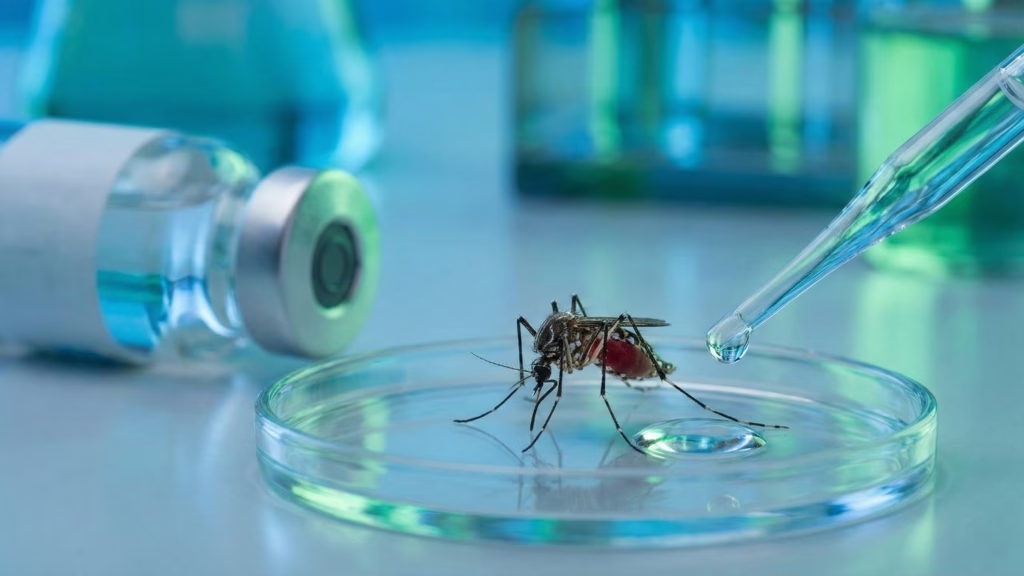
Sometimes the most promising breakthroughs arrive quietly. That seems to be the case with a drug that was once developed for dengue, then set aside and nearly forgotten. Today, it is back in the spotlight, and for good reason. New research suggests this antiviral did far more than slow the dengue virus. At higher doses, it actually blocked viral replication and sharply reduced infection rates. Scientists are now taking a fresh look at whether this long sidelined compound could finally become a targeted treatment for a disease that affects hundreds of millions of people every year.
The study, published in the New England Journal of Medicine, focuses on an antiviral called mosnodenvir. Originally developed years ago, the drug never made it to late stage clinical trials and was quietly shelved by industry. Now, detailed results from controlled human challenge studies are forcing researchers to ask an important question. Did the world walk away too soon from a potential dengue treatment?
Why Dengue Remains Such a Serious Threat
To understand why this discovery matters, it helps to look at the scale of dengue itself. Dengue is caused by four closely related viruses, all spread by Aedes mosquitoes. These mosquitoes thrive in tropical and subtropical climates, but their range is expanding as temperatures rise and urban populations grow.
For some people, dengue feels like a severe flu, with fever, body aches, and fatigue. For others, the infection can turn dangerous. Severe dengue can lead to internal bleeding, organ failure, and in some cases, death. Every year, an estimated 100 million to 400 million people are infected worldwide, and tens of thousands die from complications.
What makes dengue especially challenging is that once someone is infected, there is very little doctors can do beyond supportive care. Fluids, pain management, and close monitoring are often the only tools available. Despite decades of research and an enormous global burden, there are still no approved antiviral drugs that directly target the dengue virus.
The Limits of Vaccines Alone
In the absence of antiviral treatments, vaccines have become the main line of defense. Vaccination can reduce the risk of infection and severe disease, but it is not a perfect solution. Protective immunity takes time to develop, which makes vaccines less helpful during fast moving outbreaks. Some people cannot receive dengue vaccines at all, including those who are immunocompromised or pregnant.
At the moment, three dengue vaccines exist, but their impact has been uneven. One vaccine developed by Sanofi had a complicated rollout and limited uptake and is now being discontinued due to low demand. Another vaccine from Japanese manufacturer Takeda was approved in 2022 and is licensed in more than 40 countries, including across the European Union.
More recently, Brazil approved a single dose dengue vaccine developed by the Butantan Institute. While that is encouraging, it is still unclear how quickly production can scale or when the vaccine might become available beyond Brazil. Adding to the challenge, all existing dengue vaccines use weakened live virus, which restricts who can safely receive them.
This is where antivirals could make a critical difference. Unlike vaccines, an oral antiviral could be used during outbreaks, offered preventively in endemic regions, or given to travelers and high risk individuals after exposure. Until now, that option simply did not exist.
How Mosnodenvir Stops Dengue in Its Tracks
Mosnodenvir was originally developed by the Janssen Pharmaceutical Companies of Johnson & Johnson as a broad spectrum antiviral designed to work against all four dengue serotypes. Instead of boosting the immune system, the drug targets the virus directly inside infected cells.
It does this by interfering with a key interaction between two viral proteins, known as NS3 and NS4B. These proteins are essential for the virus to copy its genetic material. When mosnodenvir disrupts their interaction, the virus cannot replicate. In simple terms, the infection is stopped before it can really get started.
In laboratory tests, mosnodenvir showed impressive potency against many different dengue genotypes, even at very low concentrations. The drug also performed well in animal studies, including experiments in mice and nonhuman primates. Early human safety trials did not raise major red flags, suggesting the drug was generally well tolerated.
The Human Trial That Changed Everything
The most compelling evidence came from a controlled human infection study, a type of trial in which healthy volunteers are deliberately exposed to the dengue virus under carefully monitored conditions. While these studies are complex and tightly regulated, they can provide clear answers about whether a drug works.
In this trial, every participant who received a placebo became infected. The same outcome was seen in those given a low dose of mosnodenvir. Things changed as the dose increased. Among participants who received a medium dose, 17 percent showed no signs of infection. At the highest dose, 60 percent avoided infection altogether.
Even more striking was the effect on viral levels. Participants receiving the highest dose had dramatically lower amounts of viral RNA in their blood compared with those given placebo. This reduction was statistically significant and strongly suggested that the drug was blocking viral replication.
Study lead Anna Durbin described the findings as one of the clearest dose response relationships she had ever seen, calling it “one of the most beautiful dose response results” in her career.
A Promising Drug Put on Pause
Given these results, it might seem obvious that mosnodenvir would move straight into larger clinical trials. That is not what happened. In October 2024, Johnson & Johnson announced it would shut down all of its infectious disease research programs, including work on dengue. The decision was part of a broader shift in corporate priorities and was not linked to safety concerns or doubts about the drug’s effectiveness.
As a result, mosnodenvir was left in limbo. This was deeply disappointing for many researchers who had followed its development for years. Sophie Yacoub, a dengue researcher at the University of Oxford, said the decision was a major letdown for the field after a decade of careful work.
Since then, the full results of the controlled human infection study have been published, and data from two additional trials are currently under review. Those studies involved more than 30 sites across 10 countries, including the Philippines, Thailand, Peru, Brazil, and Colombia. Even with this growing body of evidence, the drug remains without a clear path forward.
Why Oral Antivirals Could Change Dengue Control
In an accompanying commentary in the New England Journal of Medicine, Xuping Xie of the University of Texas Medical Branch pointed out how transformative oral antivirals could be for dengue control. In regions where vaccination coverage is incomplete or where vaccines are not practical, a pill that directly targets the virus could reshape outbreak response.
The situation also highlights a broader problem in global health. Diseases like dengue primarily affect lower income regions, and drugs targeting them often struggle to maintain long term investment, even when early results are strong. The gap between scientific discovery and real world deployment remains a stubborn barrier.
A Narrowing Window of Opportunity
That gap is becoming harder to ignore. Dengue is spreading into new regions as climate change expands mosquito habitats. Outbreaks are becoming more frequent and more severe. The need for treatments that can be deployed quickly, without waiting weeks for immunity to develop, is growing more urgent every year.
Because mosnodenvir already has human safety data and strong evidence of effectiveness, researchers argue it could move into further trials faster than a brand new compound. Anna Durbin believes the science alone should be enough to reignite interest.
She remains optimistic that another company will step in. In her view, there is a real market and a clear public health need for a dengue antiviral, and it is only a matter of time before someone picks it up.
A Second Chance for a Critical Breakthrough
If mosnodenvir does find a new sponsor and advances through clinical trials, it could become the first targeted antiviral treatment for dengue fever. Beyond that, its story serves as a powerful reminder. Preparedness is not just about making discoveries. It is about carrying those discoveries forward before they slip away.
Sometimes, the solution the world needs has been sitting on a shelf, waiting for the right moment to be seen again.
Source: New England Journal of Medicine.