
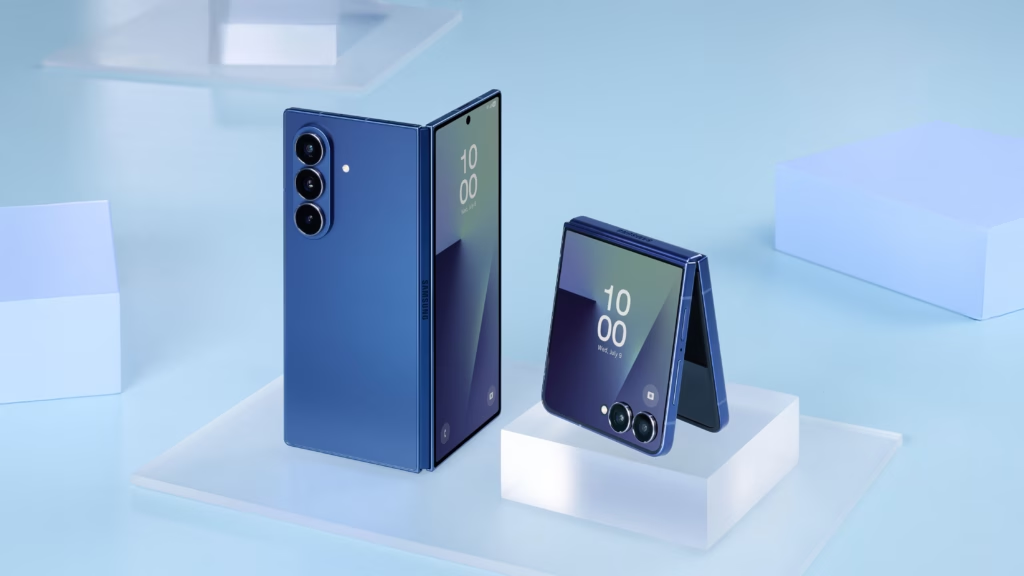
Imagine this: you open your phone so it turns into something closer to a tiny tablet. That’s not science fiction—it’s what foldable phones deliver. And over just a few years, they’ve gone from novelty to serious tech. I’d like to walk you through how fast they’ve become, why the speed matters, and where things could be headed.
When the very first foldables appeared, they had compromises. Heavier hinges, slower chips, less polished software. Now they’re getting sleek, powerful and smooth. When you peel back the layers of what “fast” means—processor speed, display refresh, app switching, battery recovery—you’ll see foldables aren’t just catching up—they’re pushing fresh boundaries.
What does “fast” mean in a foldable phone context?
When we talk about how fast a foldable phone is, we’re not just referring to “it launches apps quickly.” It’s deeper than that. It’s about several interlinked factors:
Processor and memory: The “brain” of the device, what it uses to think. A faster processor and plenty of RAM mean the phone can handle heavy tasks without lag.
Display responsiveness: Foldables often bring larger or dual-displays. A smoother experience (say, 120 Hz refresh) makes everything feel slicker.
App switching and multitasking: Because you might open a foldable and switch between apps or drag things around, the transitions must be seamless.
Hinge and mechanical responsiveness: Foldables physically change shape—so how fast and smoothly the hinge opens, how quickly the phones react after you open them matter.
Charging and battery recovery: Speed also means minimal downtime. If you can charge fast and get back to full power quickly, that counts.
Thermals and sustained performance: It’s one thing to sprint fast; it’s another to stay fast without overheating or slowing down.
When all these come together well, a foldable phone feels more capable than many “regular” phones did even a year or two ago.
The early foldables
When foldables first emerged, they were more about concept than full performance. Hefty build, unique form-factor, lots of “first-generation” trade-offs. The processors were good, but they weren’t the absolute flagship chips in many cases. Displays were lower refresh, hinges bulkier.
Because of that, they didn’t feel as snappy as premium non-foldables. That gap is closing fast.
The current generation
Over the last year or two, the pace has picked up dramatically. The latest foldables come with flagship-level silicon, ultra-smooth displays, and refined mechanics.
For example, the Samsung Galaxy Z Fold 7 5G features a custom version of the Snapdragon 8 Elite chip and 12 / 16 GB of memory. According to reviewers it “delivers performance exceeding the iPhone 16 Pro Max in multi-core tasks”.
Another example: the Vivo X Fold 5 5G is powered by the Snapdragon 8 Gen 3 (4nm process) and offers up to 16 GB LPDDR5X + UFS 4.1 storage. It boasts 120 Hz refresh on both inner and outer displays.
These show how foldables are now sitting firmly in the “flagship performance” category.
What this means for you as a user
What do you feel when you pick one of these newer foldables?
- Apps open almost instantly.
- Switching between apps and displays (outer to inner) is smoother, less stutter.
- Gaming, video editing, multitasking can be more fluid (assuming the phone is optimized).
- Displays feel more responsive: 120 Hz refresh, quicker touch response.
- Mechanical feel: hinge action is quicker, less “waiting”.
- Charging and battery recovery have improved: some models reach significant charge in minutes, meaning less downtime.
Why foldables were slower before and how they overcame those limits
To appreciate how far things have come, it helps to know why foldables lagged early on—and what engineering changes changed that.
Mechanical constraints
Foldables have to physically fold. That means hinges, additional layers, flexible displays, and protective coverings. All that adds complexity. Early models had thicker bodies, heavier weight, slower transitions from closed to open state.
Over time manufacturers refined hinge design, reduced bulk and weight, improved durability of the folding screen. As the mechanical side improved, the “feel” of speed improved.
Thermal and power issues
Because foldables often have larger displays (when open) and more complex mechanics, they generate more heat and consume more power. To avoid thermal throttling (where performance drops due to heat) manufacturers had to redesign cooling and power systems.
The move to newer process nodes (4 nm, even 3 nm) for chips helps. For example the Vivo X Fold3 Pro claimed a 30 % improvement in CPU performance and 20 % energy efficiency gains thanks to newer chip architecture.
Display and component readiness
Folding screens need to be high quality, responsive, and durable. Early ones had to compromise refresh rate or brightness. As technology matured, foldable displays caught up: 120 Hz refresh, LTPO panels (adaptive refresh), high peak brightness, etc.
Memory and storage technologies also improved: LPDDR5/5X, UFS 4.0/4.1 storage, faster read/write speeds. All that contributes to the “feel” of speed.
Software optimization
Having high-end hardware is one thing; making it work smoothly requires software that’s optimized for foldable form-factors (transitions, app continuity, outer screen to inner screen switching). As software matured, the user experience improved.
Real-life performance: what you’ll actually experience
Let’s bring it into the day-to-day. If you pick up a fast foldable today, what changes will you notice compared to a non-foldable or an older model?
App launches and switching
Open your outer screen, tap an app, then open the phone to the inner screen. With older devices you might see a slight delay or re-layout glitch. With newer foldables the transition is smooth, almost seamless.
In multitasking you might have split-screen apps or pop-ups: the faster CPU, memory and displays ensure this feels fluid rather than choppy.
Display feel
With 120 Hz refresh (or adaptive refresh) you get smoother scrolling, more responsive touch. On a big inner display (say 7.8-8 inches) this makes a difference—web pages, maps, videos all feel more alive. On the outer display it also matters: quick glance, quick reaction.
Gaming and heavy workloads
If you play games, edit video or do heavy tasks, performance and thermals matter. The CPU/GPU have to be able to maintain high speeds, not just peak once. The newer foldables are clearly stepping into this zone. For example one Fold user on Reddit noted:
“It’s VERY smooth … Everything related to the inner screen works perfectly and is super useful.”
Of course, heavy gaming still exposes limits (battery, heat) but the gap keeps narrowing.
Battery & charging
Shorter charge times and faster recovery mean less downtime. And when the phone is fast it matters that you can use it quickly and then recharge without wait. Some newer foldables boast very high-speed charging.
One Reddit comment about an early foldable said:
“Charging speed concern … once the travelling picked up and I started emulating games, it became undoable.”
That context matters. When the performance is high, everything around it (battery, charging, thermals) must keep up.
Hinge and form-factor transitions
Because you’re switching modes (closed to open), how fast and smooth the mechanical action is affects the experience. When the hinge opens cleanly, the display wakes quickly, apps resume without lag, it all feels faster. Early foldables sometimes had “waiting for screen to re-layout” or a visible fold-delay. Newer ones refine that.
Where the speed metrics stand today
Let’s look at a few specs and what they indicate about speed in foldables currently.
- The Snapdragon 8 Gen 3, found in Vivo X Fold 5, is built on 4 nm process, which offers high efficiency and performance.
- Many foldables now support 120 Hz refresh on both inner and outer displays. That refresh rate alone improves perceived speed.
- Storage types like UFS 4.0 / 4.1 give faster data transfer speeds meaning quicker app loads, quicker data access. For example the Xiaomi MIX Fold 3 uses UFS 4.0.
- Charging speeds in foldables are improving: some offer 67 W wired, 50 W wireless in foldable form-factor (example: MIX Fold 3)
- Foldables now weigh less and have thinner builds despite their complexity – this helps because less bulk often means less cooling trouble, fewer thermal bottlenecks.
So we can say: yes, foldables are fast (flagship fast in many respects). The margin between them and “regular” phones is shrinking and in some cases they surpass negatives of non-foldables by offering more screen real estate and more advanced features without major slowdowns.
What are the limits still? Where don’t they feel “instantly perfect”?
Even though foldables are much faster than before, they aren’t perfect. There remain trade-offs and areas where speed could still improve.
Thermal throttling under sustained load
A device may hit top speed for a moment, but if it’s doing heavy load (gaming, 4K video, nonstop usage) for a while, heat builds, performance drops. For example one Reddit user noted for the Z Fold 7:
“Fold 7 loses about 57% of its performance after 20 minutes. … So whatever heat dissipation solution they’ve opted for with the Fold 7 is significantly worse than the S25U.”
So while peak speed is high, sustained high performance and cooling are still challenging.
Charging and battery constraints
Even though charging speeds are improving, foldables often pack large displays, dual components, which means power demands are high. Sometimes charging is still slower than hoped, or battery life is less than ideal in heavy use. One report:
“The listings reveal … both phones will offer 25W wired charging … That means even the $500 Galaxy A56 has faster charging speeds.”
So don’t assume every foldable will charge at the fastest rate.
Cost vs performance trade-offs
Some foldables might skimp on certain performance aspects (cooling, battery size) in favor of design, thinness, or hinge refinement. This can affect how “fast” they feel in real life. Specs can look great, but the real-world experience depends on the whole package.
Software and app-continuity issues
Because of the two-screen / folded form factor, some apps may not fully optimize for the transition. Opening an app on the outer screen then switching to inner may still involve a re-layout or reload. With older models this could cause a noticeable lag. While newer models improve, it’s still an area of difference.
Why speed matters in a foldable exactly
You might wonder “my current smartphone is fast already—why should I care about speed in a foldable?” Great question. Here are some reasons why speed becomes more important in the context of a foldable.
More screen, more tasks
With a foldable you often have a larger inner display (tablet-like) plus an outer display. That means you’ll be doing more: multitasking, split-screen, drag-and-drop, perhaps using it like a mini tablet. All this demands faster hardware so things feel smooth.
The transition moment
When you open or close the foldable, you expect near-instant responsiveness. If it lags or stutters just when the hinge opens, the experience feels “non-premium”. Speed makes that experience seamless and fluid.
Future-proofing
Because foldables are pricey, you want them to last. Having more performance headroom means the device can handle future software updates, more demanding apps and features, without feeling slow in a year or two. So choosing a faster foldable is partly investment protection.
Because form factor already compromises something
Foldables have to incorporate complex mechanics. If you then accept a slower processor or slower storage just because of novelty, you might feel the compromise. But when you ensure speed is strong, you start to get “both form + function”.
How fast some of today’s foldables are
Let’s look more closely at a few specific models to illustrate how far performance has come.
Samsung Galaxy Z Fold 7 5G
This is a flagship foldable that pushes the envelope. Powered by a customized Snapdragon 8 Elite chip, it delivers excellent multi-core performance. Reviews have suggested that it may even outpace some leading non-foldables in benchmark tests.
In practical use, reviewers noted it feels very light, very smooth. One user said:
“It’s VERY smooth … Everything related to the inner screen works perfectly and is super useful.”
That’s what speed and refinement give you.
Vivo X Fold 5 5G
This model illustrates how foldables are becoming accessible with top specs. With Snapdragon 8 Gen 3, dual 120 Hz displays, high refresh rate outer and inner, plus fast storage and RAM, it delivers flagship-level speed and usability.
For someone who wants cutting-edge features in the foldable form, this shows how “fast” is no longer a secondary concern—it’s core.
Xiaomi MIX Fold 3
While not always globally available, it demonstrates the push in hardware: UFS 4.0 storage, big displays, premium chipsets. For example: it uses a Snapdragon 8 Gen 2 (4 nm). Wikipedia
It shows the trickle‐down of performance from the very best to foldables.
What to look for if you’re choosing a foldable and care about speed
If you’re shopping and want a foldable phone that feels fast (and stays fast), here are some key specifications and features to pay attention to.
- Chipset generation: newer process node (4 nm, even 3 nm) = better performance and efficiency.
- RAM and storage: look for 12-16 GB RAM + UFS 4.0/4.1 storage if possible.
- Display refresh rate: 120 Hz is now common; some phones may offer adaptive refresh (to save battery).
- Outer display performance: don’t just focus on the big inner display—the outer display should be responsive too.
- Charging speed and battery size: a fast chip demands a fast recharge system so the experience stays smooth.
- Cooling and sustained performance: check reviews for thermal behaviour (does it slow down under load?).
- Software optimization for foldable form factor: look for how well apps handle transition outer ↔ inner screen.
- Build quality and hinge: smooth, quick folding/unfolding helps make the “feel” of speed better.
- Update longevity: a fast device now will stay feeling snappy if it gets software updates for several years.
Where this technology is headed: what’s next for foldable performance?
The story doesn’t stop here. Foldables are just entering a phase of rapid innovation, and speed will keep improving. Here are some directions you might see.
Even faster chips and smaller nodes
If chip manufacturers move to 3 nm or beyond in mobile space, foldables will benefit. More efficiency means less heat, better battery life, more sustained performance.
Displays that do more
Foldable displays might not only fold, but roll, expand, or support different aspect ratios. Faster refresh rates (144 Hz or 165 Hz), better adaptive refresh logic, higher touch sampling rates—all add to the perception of speed.
Smarter multitasking and app continuity
As software evolves, foldables may provide seamless transitions between display modes, smarter layout switching, drag-and-drop between inner and outer screens, etc. This means speed not just in raw hardware, but in workflow.
Better thermals and materials
Because foldables have complex mechanics, innovations in materials (lighter, better heat dissipation) and hinge design will matter. If a phone can stay performance-peak longer, it “feels” faster in real life.
Integration with AI and sensors
Foldables may incorporate more AI features (on-device processing) which demand speed. The ability to handle these seamlessly without lag will make the device feel future-ready.
Charging, battery and overall system optimizations
Faster charging, better battery chemistry, smarter power management—all will help the perceived and actual speed of use. You’ll use it more, charge less, and feel the responsiveness.
How you might feel the difference in your everyday life
To make it really concrete: if you upgrade from a “regular” flagship phone from two years ago to a modern foldable with strong speed specs, you might notice:
- Quicker app opening, fewer delays.
- Smooth switching between outer screen to inner screen (and back) without “pause”.
- Better multitasking: streaming on inner screen while checking something on outer screen.
- Larger display usable without lag—even when you open it mid-use (camera, messages, whatever).
- Feeling of “premium” when you open the phone and it instantly adapts.
- Less frustration when doing something heavy (game, photo edit, multi-window).
- Longer until you feel “I wish it were faster”.
Is there a point of diminishing returns?
Yes. At some point, raw benchmark numbers matter less than the holistic experience. If a foldable already runs everything you use smoothly, making it “faster” will have less perceivable benefit for some users. But given how foldables add new dimensions (form factor, display size, multi-screen) the speed improvements matter more here than on a “normal” slab phone.
If you’re a casual user—browsing, social media, photos—the difference between “fast enough” and “blazingly fast” may be marginal. But if you’re someone who uses multitasking, editing, gaming, or you want the form factor to be genuinely useful and not just gimmick—then the speed certainly matters.
Should you buy a foldable now if speed is your priority?
Yes—if you pick the right model. The technology has matured significantly and the latest foldables deliver performance that matches or exceeds many “regular” high-end phones. If you choose a top-tier foldable with capable hardware, you’ll get both the novelty of the form factor and the performance to make it worthwhile.
However, do your homework: compare models, read reviews (especially about sustained performance/thermals), check charging speeds, outer display usability, and software support. Because the form-factor adds complexity, some models may compromise somewhere. But if you pick carefully, you’ll be getting a “fast” phone that happens to fold.
If you aren’t ready to spend top money, or you don’t need the extra screen real-estate, you might wait. But if you want the “next level” experience today, a fast foldable is an excellent choice.
Final thoughts
We’ve come a long way. Foldable phones that once were slower, bulkier and more “prototype-feeling” are now powerful, smooth and refined. When a device opens, transitions seamlessly, your apps launch instantly and the display responds without lag—then the form factor stops feeling like a compromise and starts feeling like an advantage.
Speed matters in a foldable more than ever because the unique nature of the device amplifies any lag or stutter. The good news is that today’s foldables show us how far the tech has progressed. The next leap will be even more interesting—faster chips, smarter displays, refined hinges and better user experiences.
If you’re thinking of diving into the foldable world and want something that doesn’t feel “slower” than your current phone, you’re in a great moment. The phones are fast. Faster than they’ve ever been. They’re ready for you.
If you like, I can pull up a comparison table of the fastest foldables in India currently (speeds, specs, and real-world performance) so you can see which one gives you the most for your budget. Would you like that