
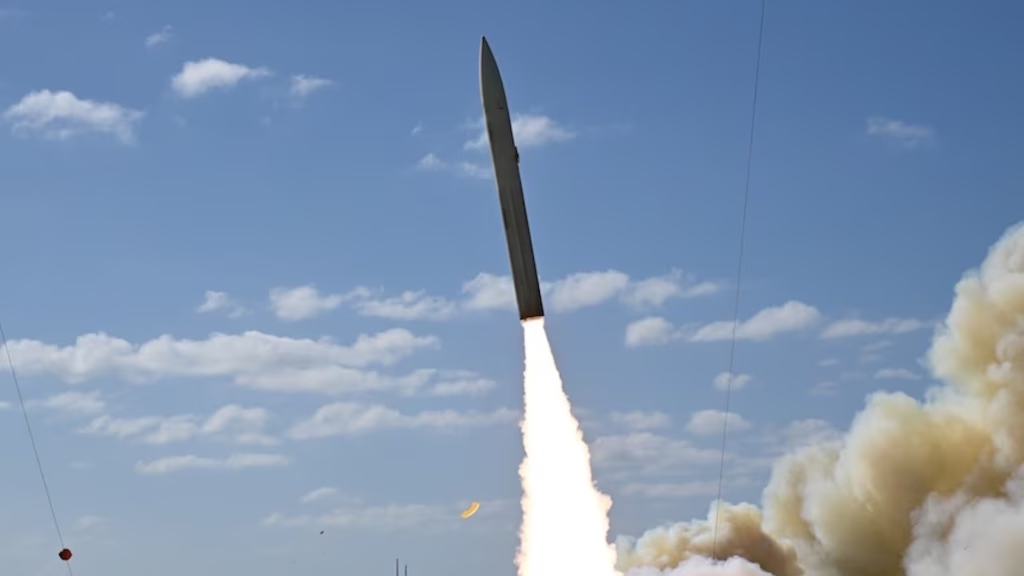
The United States has made a major shift in how it handles one of its most advanced weapons, the Long-Range Hypersonic Weapon, also known as Dark Eagle. This system is no longer treated as just another battlefield tool. It has now been placed under the authority of U.S. Strategic Command, putting it in the same category as some of the country’s most powerful strategic systems.
What this really means is that control over Dark Eagle has moved up to the highest levels of decision-making. Instead of field commanders deciding when to use it, every strike now requires approval from national leadership. The chain of command runs directly from top officials to Strategic Command, and then to the units that carry out the launch. Even though the weapon uses a conventional payload, it is now managed with the same level of oversight as systems tied to nuclear deterrence.
This is a big change from how the system was originally intended to operate. Before, it was seen as a long-range option for theater commanders in active conflict zones. Now, that authority has been removed. Operational units can still launch the missile, but they cannot decide when to do so. That responsibility sits firmly at the national level, making sure every use aligns with broader strategic goals.
At its core, Dark Eagle is designed for speed and precision. It uses a two-stage solid-fuel booster to launch a hypersonic glide body. Once released, the glide body travels through the atmosphere at speeds above Mach 5, maneuvering along the way. This makes it much harder to detect and intercept compared to traditional ballistic missiles. Depending on the target, it can travel distances between 2,700 and 3,500 kilometers in as little as 15 to 20 minutes.
Even though the warhead itself is relatively small, the sheer speed of the impact creates massive destructive force. The energy released on impact can be comparable to hundreds of kilograms of TNT, concentrated in a very small area. This allows it to penetrate deeply and deliver extreme pressure on high-value targets.
Getting to this point hasn’t been easy. The program faced several setbacks in earlier years, including failed tests and canceled launches. But things turned around with a successful test in mid-2024, followed by another later that year. A joint test between the Army and Navy in 2026 confirmed that the shared design is working as planned.
In terms of its role, Dark Eagle is meant for very specific, high-priority missions. It’s not a weapon that will be used frequently. Instead, it’s reserved for targets that are both critical and time-sensitive, like advanced air defense systems, command centers, missile launchers, and radar installations. Each battery only carries a limited number of missiles, and production is still relatively slow, which means every shot counts.
This new command structure also gives the United States a powerful option that sits between conventional and nuclear weapons. It allows for rapid, long-range strikes without crossing the nuclear threshold. By bringing Dark Eagle under Strategic Command, the system becomes a tightly controlled tool that can deliver fast, precise, and high-impact results when it matters most.